
The authoritative guide as to eligibility for a grant is the “Boiler Upgrade Scheme: Installer Guidance V4.2”. This guidance applies to applications properly made on or after 8 May 2024.
The authoritative guide as to eligibility for a grant is the “Boiler Upgrade Scheme: Installer Guidance V4.2”. This guidance applies to applications properly made on or after 8 May 2024. 3. You can down load the complete guide using the link below however I have reproduced the eligibility requirements in section 3 for convenience in this post.
This guidance is for installers who want to benefit from the Boiler Upgrade Scheme
(BUS). The BUS offers upfront grants to reduce the installation cost of low carbon
heating technologies.
This guidance details which low carbon heating technologies and properties should be
eligible. It explains how installers who can make an application, what is required from
them, our approach to audit and compliance and useful contacts.
https://www.ofgem.gov.uk/sites/default/files/2025-04/BUS_Guidance_for_Installers_-V4.2.pdf
3. Eligibility requirements Installer requirements
This section sets out the requirements that installers, properties and installations must meet in order to be eligible to receive a BUS voucher and grant. It covers the criteria that all installations must meet, and the criteria that are specific to certain technologies. It also describes how installers need to evidence that the eligibility criteria have been met.
3.1. Installers must be MCS accredited and certified to install heat pumps or biomass boilers, or both, or certified by an MCS equivalent scheme. 30
3.2. The Secretary of State is responsible for determining whether a scheme is equivalent to MCS. There are currently no schemes determined by the Secretary of State to be equivalent to MCS.
3.3. MCS installers need to create an account ahead of making any BUS voucher applications and voucher redemption applications. Please see chapter 4 for further information.
3.4. MCS installers may employ sub-contractors in line with the MCS standards. 3.5. The BUS voucher application must be submitted by an authorised user from the BUS installer account.
3.6. Installers cannot use a temporary MCS certification number to create an account or apply for a voucher. If installers are not MCS certified and wish to obtain MCS certification through an installation that they then intend to receive a BUS grant for, they need to complete the installation and gain certification before they can create an account and apply for a voucher which they can do retrospectively. If an installer installs and commissions a heat pump or biomass boiler before they are granted a BUS voucher, they are doing so at additional risk.
3.7. Where this is the case, applications must be submitted and properly made no more
than 120 days after the system has commissioned. If the application is properly made more
than 120 days after it has been commissioned, it will not be eligible. Please see section 3.52
for more information on this.
3.8. If an installer’s MCS certification expires or changes after a BUS account has been
created, we will not issue vouchers or make any redemption payments until the installer
provides Ofgem with updated information.
3.7. Where this is the case, applications must be submitted and properly made no more
than 120 days after the system has commissioned. If the application is properly made more
than 120 days after it has been commissioned, it will not be eligible. Please see section 3.52
for more information on this.
3.8. If an installer’s MCS certification expires or changes after a BUS account has been
created, we will not issue vouchers or make any redemption payments until the installer
provides Ofgem with updated information.
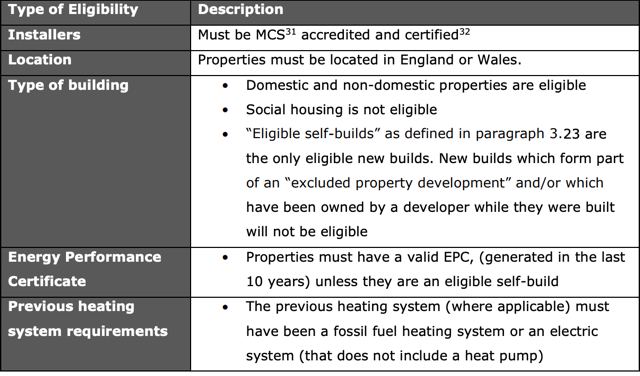
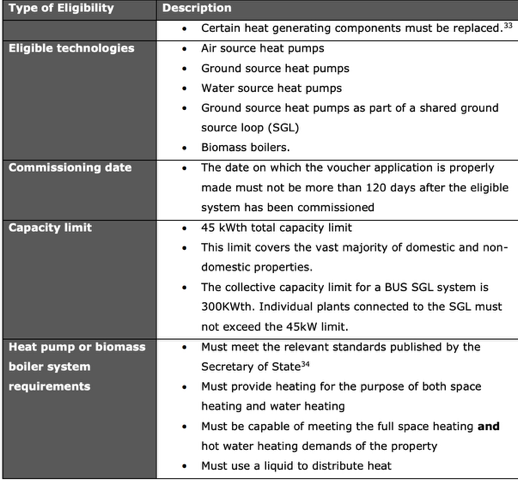
3.9. Table 1 summarises the main eligibility criteria. These requirements are set out in
more detail from paragraph 3.10 to paragraph 3.96. Applicants should make sure they read
and fully understand all the eligibility requirements before making an application.
Table 1 – Summary of general eligibility requirements
Property requirements
3.10. Only properties in England and Wales are eligible.
3.11. Domestic and non-domestic properties are eligible. The eligibility requirements are the
same for domestic and non-domestic properties.35
3.12. Properties must have a valid Energy Performance Certificate (EPC) (ie no more than 10
years old) unless they meet the definition of an eligible self-build set out in paragraph 3.26
3.13. Domestic and non-domestic properties include, but are not limited to, owner-occupied
properties, properties rented out to tenants, second homes and holiday homes.
3.14. Properties such as churches and park homes may be eligible if an EPC can be issued on
the basis that it is a property, and all other eligibility requirements are met.
3.15. Where an individual owns multiple properties, they may apply for a BUS voucher for
each property. The BUS regulations permit one voucher to be redeemed per legally separate
property.
Requirements for retrofit properties
3.16. Where a property has had any previous heating system installed and was first occupied
or used before the BUS funded installation was commissioned, the following requirements will
apply. Separate requirements for eligible self-builds are set out below from paragraphs 3.26
to 3.41.
3.17. A property cannot have received previous funding or support from public funds or
government schemes such as ECO and RHI for a previous low carbon heating system.
Existing heating system requirements
3.18. The previous heating system in the property, which is being replaced by the BUS
funded installation, must have been a fossil fuel-based heating system or an electric heating system (not including heat pumps).
36 Evidence of the previous heating system should always be obtained by installers. This may be requested as part of our checks where required. A replacement fossil fuel- based heating system must have been fuelled by:
- Gas37
- Oil
- LPG
- Coal
This list is not exhaustive; please see the glossary for the full meaning of ‘fossil fuel’
3.19. Electric heating systems include storage heaters, electric panel radiators and electric
boilers.
3.20. We expect that, in limited cases, where the previous heating system has been disposed
of, installers may need to seek evidence from property owners that the previous heating
system was a fossil fuel or electric heating system. In these cases, installers should satisfy
themselves that the previous heating system was eligible to be replaced with the support of a
BUS grant. Evidence types that they may wish to consider in these cases include but are not
limited to:
o a previous EPC38 for the property that lists a fossil fuel or electricity as the main
heating fuel
o previous bills or fuel delivery receipts
o evidence of a gas meter being removedo documentation evidencing the gas connection to the property being capped or
clamped
o photographic evidence of the previous heating system in situ and after removal
Energy Performance Certificates (EPCs)
3.21. A valid EPC must be provided for the property at the voucher application stage only,
unless the property is an eligible self-build.39 A valid EPC means the most recent EPC issued
for the property and one which is no more than 10 years old.
40 An EPC is not required at
the voucher redemption stage.
3.22. For information on Energy Performance Certificates please see the GOV.UK website41
and for access to a property’s EPC, please refer to the EPC register.42
Insulation Recommendations on an EPC
3.23. From 8 May 2024, we accept EPCs with insulation recommendations. However, we
expect that installers have a discussion with the property owner about the benefits of energy
efficiency measures, such as cavity wall and loft insulation, and potential measures the
property owner could take.
3.24. It is important that property owners understand that heat pumps perform best in a
well-insulated property. Insulation measures, such as cavity wall and loft insulation, are
relatively low-cost measures that could reduce energy bills and increase heat retention in a
property. For example, without loft insulation, around a quarter of heat is lost through the
roof. These types of insulation help to keep heat inside the home, making it more comfortable
and lowering heating costs.
3.25. More information around energy efficiency measures can be found on the government
website.43
Requirements for Eligible self-builds
Properties which have not had any previous heating system installed and have not
been occupied or used prior to commissioning of the eligible heat pump, will be
assessed against the self-build eligibility requirements.
3.26. Self-builds can be eligible for BUS funding for heat pumps. Biomass boilers are not
eligible for BUS funding in self-builds.44
.
3.27 to 3.45 relate to the eligible self-builds and other applications not related to system eligibility FOR BREVITY I HAVE NOT REPRODUCED PARA 3.27 TO 3.43
New heating system requirements
General requirements
3.44. Air source heat pumps, ground source heat pumps (including water source heat pumps
and shared ground loops) and biomass boilers are the eligible technologies52 under BUS.
They must meet the requirements of the latest MCS standards, and the standards approved
and published by the Secretary of State.
53 The following section sets out general
requirements for all technologies. For technology specific requirements, please see the
sections on heat pumps (paragraphs 3.73-3.92) and biomass boilers (paragraphs 3.93-
3.106).
3.45. A heat pump or a biomass boiler installed under BUS must be an eligible plant,
meaning it must comply with the requirements in the relevant provisions of the BUS
Regulations54
3.46. These requirements are that the eligible plant must comprise the heat pump or
biomass boiler and all ancillary equipment. The ancillary equipment is also essential for the
commissioning of the eligible plant. The ancillary equipment includes but is not limited to:
Pipework
Heat emitters such as radiators
Hot water cylinders or buffer tanks
Heating controls
Valves and isolators
3.47. An eligible plant’s ancillary equipment does not need to be new and can be retained
from the previous fossil fuel or electric heating system. More detail is given at paragraph 3.55
and table 2.
3.48. The maximum permitted capacity of the system being installed is 45 kWth.
55
Shared ground loop systems have a maximum permitted capacity of 300 kWth for the whole
system56
. The capacity of individual heat pumps connected to a shared ground loop must not
exceed 45 kWth.
3.49. Heat pumps and biomass boilers must distribute heat using a liquid (normally
through radiators or underfloor heating) to provide both space heating and hot water.
57
3.50. The heat pump or biomass boiler must provide both space and hot water heating
to the property.
3.51. The heat pump or biomass boiler must be capable of meeting the full space
heating and hot water heating demands of the property or to a single eligible property
and any related property.58 The new heating system can provide the partial or full heat needs
of the related property, however, must provide the full needs of the main property. The
installer will need to confirm this requirement is met via a declaration and we will check
against the MCS certificate after the installation has commissioned.
3.52. A related property includes adjoining properties, such as an annex or swimming pool,
which the owner of the property can use, and which are not covered by the first property’s
EPC.
3.53. ‘Hot water heating demands of the property’ refers to the hot water intended for
the personal use of the individuals who use or occupy the eligible property. It is permitted
for the heat pump or biomass boiler to also provide hot water for the purposes of heating a
swimming pool or carrying out a process, but these hot water heating needs do not have to
be met for the heat pump or biomass boiler to be eligible.
59
3.54. The new low carbon heating system will need to completely replace an existing
fossil fuel heating system or electric heating system which does not include a heat
pump. Electric heating systems can include but are not limited to storage heaters, electric
panel radiators and electric boilers. Certain heat generating components of the original
heating system can be retained.
60 The BUS regulations allow for circulation pumps, solar thermal collectors, and supplementary electric heaters (including immersion heaters) to be retained. We do not consider wood burning stoves to be part of the original heating system
and as such they may be retained.
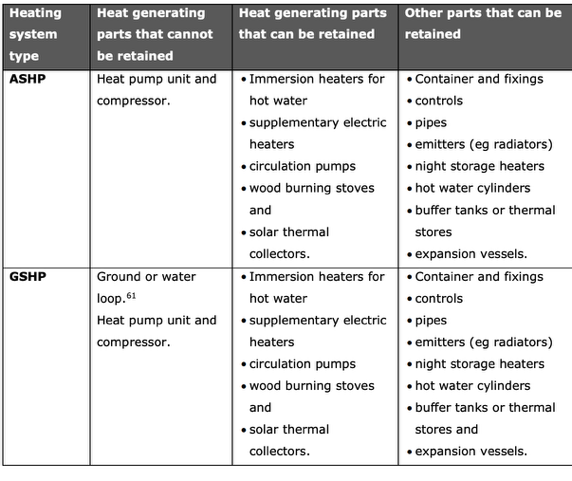
3.55. Non-heat generating components can also be retained from the original heating
system. More detail on which parts can be retained is provided in Table 2.
Table 2- Parts that can and cannot be used before the heating system is first
commissioned.
3.56. Existing low-carbon technologies such as solar panels may be retained, so long as they
are not the main source for the purposes of providing space heating or hot water to the
property – this must be provided by the BUS funded heat pump or biomass boiler.
3.57. Where parts are retained, the heat pump or biomass boiler must be sufficient in size,
and installed in such a way, that were the retained heat generating components not there, it
would be able to provide space heating and hot water to the property on its own.
3.58. The installation of some low-carbon technologies alongside the installation of the BUS
funded plant is permitted so long as the heat pump or biomass boiler is capable of meeting
the full space heating and hot water heating demands of the property. Other low-carbon
technologies that may be permitted are supplementary electric heaters, including any
immersion heaters, circulation pumps or solar thermal collectors.
3.59. Heat pump systems which use a combination of a fossil fuel boiler and a heat pump
are not supported under the BUS.
Commissioning Date eligibility:
3.60. We strongly encourage installers to wait until a voucher application has been made and
the voucher issued before commissioning the eligible system at a property. However, we understand that in some circumstances, commissioning may occur prior to submitting a
voucher application, but installers do so at additional risk of not receiving a BUS voucher.
3.61. Commissioning occurs when the installer has tested and signed off on the installed
system. A heating system is first commissioned upon the completion of procedures and tests
undertaken to the usual industry standards and practices for the specific type of system
which demonstrate that the system is capable of operating and generating heat. A system
can only have been commissioned when the whole heat pump or biomass boiler system,
(including every emitter62 included in system design), has been installed and tested in
accordance with MCS standards and manufacturer requirements. We will usually accept the
first commissioning date stated on the MCS installation certificate but may require additional
evidence to verify this.
3.62. Where a system has been commissioned prior to submitting a voucher application,
installers must ensure that the voucher application has been, or will be, properly made within
120 days of the commissioning date stated on the MCS certificate. A system that is
commissioned more than 120 days before the date on which the voucher application is
properly made will not be eligible on BUS. This also applies to any application that has reapplied following a withdrawal, revocation or voucher expiry. The scheme is installer led, and
as such, it is the installer’s responsibility to ensure their applications meet the eligibility
requirements.
3.63. A voucher application is only considered ‘properly made’63 once we have all the
necessary information to make an assessment on eligibility, and the property owner has
provided all the required information to confirm consent and their identity in addition to the
information submitted by the installer. At redemption stage an application is ‘properly made’
when we have all the information required as part of a redemption. Where further information
is requested by us an application will not be considered as ‘properly made’ until this
information is provided.
3.64. Ofgem may grant an extension to the 120-day commissioning rule, in very limited
circumstances, where the length of time taken to reach certain administrative decisions
results (or is likely to result) in the 120-day period being exceeded for a re-application.
Extensions may only be granted where Ofgem deems it reasonable to do so and where we
assess that an application could be brought into compliance and re-submitted.
Ofgem may grant an extension:
- Where a voucher application has been rejected64
- Where a voucher redemption has been rejected65
- Where a voucher has been revoked66
- Where a sanction has been revoked67
- Where Ofgem take a decision regarding a right of review68
3.65. It is permissible for the heating system to be installed and used in limited
circumstances (eg, for drying out plasterwork during construction or renovation works) before
the system is formally commissioned
.Ofgem PEL
3.66. The Ofgem Product Eligibility List (PEL) is an administrative tool that makes it easier to
identify products that could be eligible for the BUS. All products on the Ofgem PEL are
extracted from the MCS certified product directory, where they also meet the MCS standards
required by BUS. The MCS standards required by BUS are approved by Secretary of State as
set out under the BUS regulations69
3.67. The PEL only identifies products that meet the MCS standards and, in the case of
biomass boilers, have an eligible emissions certificate. There are many other eligibility
requirements under BUS, including technology specific technical requirements, and the PEL
does not ensure compliance with these requirements. All BUS eligibility requirements are outlined in the BUS regulations and Ofgem’s guidance. Installers are responsible for making sure installations meet these eligibility requirements and must not rely on the PEL alone.
There may be cases where a product is on the PEL, due to meeting the MCS standards
requirement, but ineligible for BUS for a different reason. Where this is the case, we will
reject the application.
3.68. The PEL does not consider the SCOP of heat pumps. Installers need to calculate this
separately. The Ofgem PEL is not exhaustive – there may be some products on the MCS
certified product directory that do meet the requirements for BUS but are not on the Ofgem
PEL.
3.69. Where MCS standards as approved by DESNZ have been updated, the relevant
standards at the time of commissioning will be used to assess eligibility.
3.70. The PEL is updated on a monthly basis.
3.71. In order to be listed on the PEL, MCS certified biomass boilers also require an
emissions certificate meeting the scheme air quality requirements70
. For MCS certified
biomass boilers that are not on the PEL due to a missing emissions certificate, an eligible
emissions certificate71 will need to be submitted as part of a voucher redemption process. If
we are satisfied it meets the requirements, we will update the PEL.
3.72. Ofgem will not be adding new heat pumps or biomass products to the PEL at the
request of manufacturers or suppliers. Only heat pumps or biomass products and
emissions certificates that are submitted as part of a voucher redemption
application will be reviewed.
Hybrid heat pumps
3.83. Some heat pumps can be categorised as “hybrid products”. These are heat pumps
which are designed to work with or are integrated with another technology type. If your heat
pump is installed as a hybrid, then it is unlikely to be eligible to apply for BUS. Some systems
that can be installed as a hybrid may be eligible if they are installed as a standalone unit and
replace an existing system. Upon receiving an application, we will assess the product against
the criteria set out in the regulations to determine if it is eligible. While we cannot provide an
up-front assessment of eligibility for each and every product, we have provided a nonexhaustive list of example hybrid systems below.
3.84. Integrated fossil fuel hybrid systems: Heat pump systems which include an
integrated fossil fuel boiler do not meet the definition of air source or ground source heat pumps given in the regulations.78 Therefore, they are ineligible for BUS. Examples include gas
and oil boilers. This list in not exhaustive.
3.85. Fossil fuel hybrid compatible systems: Systems which comprise both a heat pump
and a fossil fuel boiler are ineligible. Heat pump systems which have the capability to be
installed alongside a fossil fuel boiler may be eligible for BUS where a fossil fuel boiler is not
present.
3.86. Solar photovoltaic (PV) compatible systems: Heat pumps which can be installed
to integrate a solar PV product may be eligible for BUS. Typically, the solar PV installation
only contributes to the electrical input required of the heat pump and does not directly
generate heat.
Cascade systems
3.87. Cascade systems can be eligible under BUS, but only one voucher maybe issued
for a cascade system. Cascade systems are systems that serve the hot water and space
heating needs of a single eligible property (or that property and a related property) and are
made up of more than one heat pump. For example, two hydraulically linked air source
heat pumps serving just one property would constitute a cascade system.
3.88. The following cascade system setups may be eligible on BUS, provided that they
serve only an individual property (or an individual property and a related
property)
3.89. Air source and air source heat pumps: Heat pump systems which are comprised of
two or more air source heat pumps. The total capacity of the system must not exceed
45kwth.
3.90. Ground source and ground source heat pumps: Heat pump systems which are
comprised of two or more ground source heat pumps. The total capacity of the system must not exceed 45kwth. This setup is distinct from a shared ground loop system because all heat
pumps are providing heat to the same property, as opposed to one property each.
3.91. Air source and ground source heat pumps: Heat pump systems which are
comprised of both air-source and ground-source heating 80
. The total capacity of the system
must not exceed 45kwth.
.